Best USB Microphones 2026
Here are the best USB microphones for 2026 — 5 picks from PCMag’s “The Best USB Microphones” (updated July 10, 2026), covering a wireless creator system, a USB condenser with analog compression, an all-in-one streaming package, an XLR bundle for beginners, and a vocal mic with a built-in interface. One honest note up front: PCMag’s list is not made up only of plug-in USB desktop mics — the DJI pick is a wireless system and the SteelSeries pick is an XLR mic with its own mixer — so each section below says plainly what kind of mic it actually is.
How this list was built: the 5 microphones below are picks from PCMag’s list. Features and downsides follow PCMag’s write-ups, and photos and stock follow the manufacturers’ and merchants’ own listings for the exact models; these microphones were not re-tested by us. One swap was made for a clear reason: PCMag’s #3 pick, the Joby Wavo POD, is listed as Discontinued at B&H and no longer appears on Joby’s own site, so it is not included here; PCMag’s #6 pick, the Shure MV7i, takes its place. PCMag’s purchase links for these models could not be verified as product links — landing on Amazon produced an access wall rather than a product page — so this article carries no purchase links. Check a retailer’s page for the current price and stock.
Key Takeaways
- The DJI Mic Mini is PCMag’s Best for Creators on the Go: a tiny wireless system that works with most phones and tablets, not a desk mic.
- The Apogee HypeMiC is the pick for analog compression: a USB condenser mic that shapes the signal before it goes digital.
- The Sennheiser Profile Streaming Set is the all-in-one package: mic, boom arm, and onboard controls in one box.
- The SteelSeries Alias Pro is an XLR mic plus mixer bundle, built for beginners who want a full streaming setup.
- The Shure MV7i is the vocal pick: warm sound, a built-in pop filter and denoiser, plus a second analog input for two-track recording.
Top 3 Picks
Comparison Table
| Microphone | Type | Best for | Standout feature | Limitation to know |
|---|---|---|---|---|
| DJI Mic Mini | Wireless system | Creators on the go | Tiny transmitters, long battery life, outstanding range | Needs a phone or camera; no low-latency monitoring |
| Apogee HypeMiC | USB condenser | Analog compression | Built-in analog compressor; case and mounts included | “Smash mode” can be over the top |
| Sennheiser Profile Streaming Set | USB mic + boom arm | All-in-one streaming | Onboard controls and sturdy boom arm | No pop filter; no effects software |
| SteelSeries Alias Pro | XLR mic + mixer | Beginner XLR setup | Mic and mixer bundle with powerful streaming software | Single-port mixer takes no second mic |
| Shure MV7i | USB mic + interface | Vocals | Second analog input for two-track recording | No stand included |
1. DJI Mic Mini — Best for Creators on the Go

DJI Mic Mini
A pocket-sized wireless mic system with clean, warm audio, effective noise reduction, and long battery life for phone and tablet recording.
The DJI Mic Mini is a wireless microphone system scaled down from DJI’s Mic 2 in size and features — transmitters, a receiver, and a charging case — not a conventional plug-in USB desktop microphone. PCMag calls it simple to use, working with most phones and tablets, and says it records clean, warm audio usable in the studio and beyond. Its strengths are its incredibly small size, high-quality audio capture, effective noise reduction, long battery life, flexible connectivity, and outstanding range.
Pros: incredibly small; high-quality audio capture; effective noise reduction; long battery life; flexible connectivity; outstanding range.
Cons: requires a Bluetooth connection; may be overkill for stationary users; no low-latency monitoring; cannot record without a phone or camera.
Best for: creators who record on the move with a phone or tablet and want a mic that disappears into a shoot. Skip if: you sit at one desk and want a simple plug-in mic — this system’s wireless kit is more than that job needs.
2. Apogee HypeMiC — Best for Analog Compression
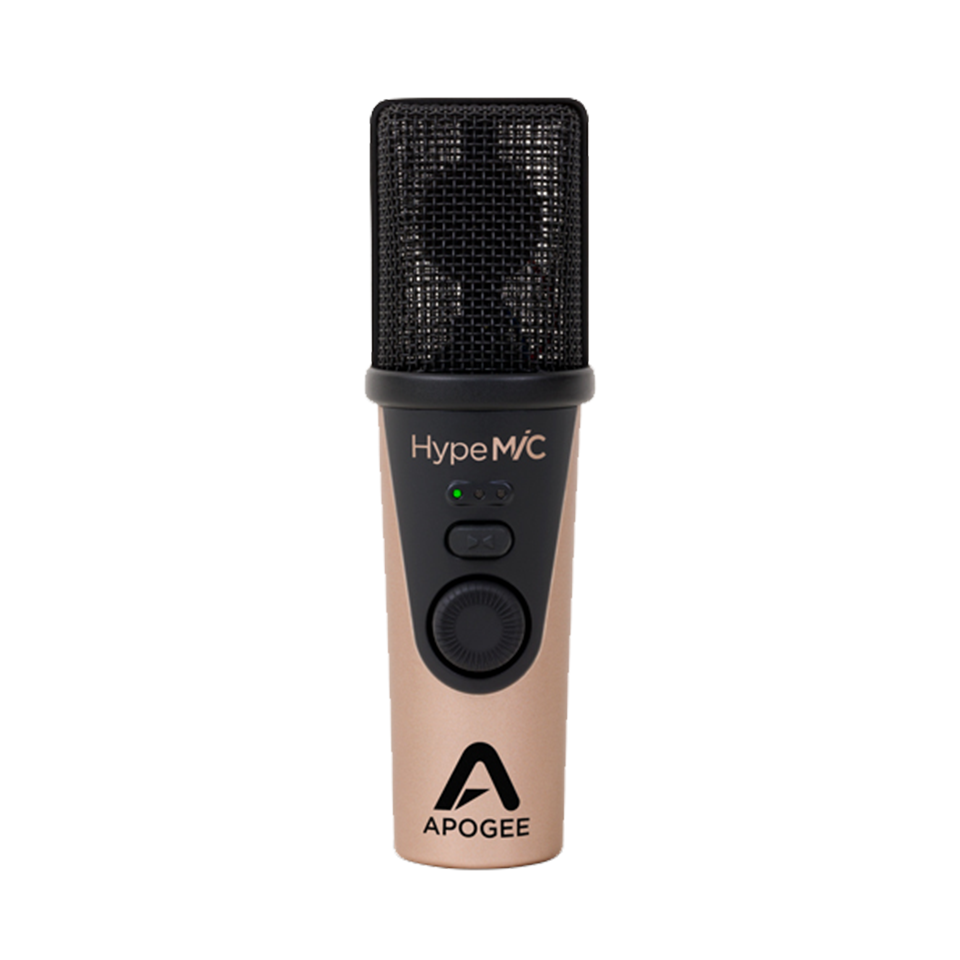
The Apogee HypeMiC is a USB condenser microphone with a built-in analog compressor. PCMag notes it is a few years old but still deserves attention, because the compressor helps get the most out of the mic signal before it is converted to digital — especially where peaks are an issue. It comes with a good tripod stand and mic stand mount, plus a pop filter and carrying case.
Pros: excellent mic signal with strong clarity and analog compression; good tripod stand and mic stand mount; pop filter and carrying case included.
Cons: PCMag flags the cost as a downside; “Smash mode” is a bit over the top.
Best for: voice recording where peaks and dynamics matter and you want compression handled in hardware. Skip if: you only need a basic mic for calls — the compressor is the reason to buy this one.
3. Sennheiser Profile Streaming Set — Best All-in-One Package

The Sennheiser Profile Streaming Set is a USB vocal microphone sold as an all-in-one package — in contrast to most USB mics, which come with only a functional table stand. It pairs a quality vocal mic with a transparent signal with onboard gain, mix, and headphone controls, a sturdy boom arm, and a long cable.
Pros: quality vocal mic with a transparent signal; onboard gain, mix, and headphone controls; sturdy boom arm; long cable.
Cons: lacks software with effects and presets; does not include a pop filter.
Best for: streamers who want one box with mic, arm, and controls and no extra shopping. Skip if: you want built-in vocal effects or a bundled pop filter.
4. SteelSeries Alias Pro — Best XLR Mic for Beginners

The SteelSeries Alias Pro is an all-in-one XLR solution that includes both a microphone and a mixer — PCMag presents it as an XLR microphone with an included mixer, not as a direct USB microphone on its own. It offers excellent sound and a clear signal, powerful streaming software with multiple audio sources and outputs, parametric EQ for both mic and outputs, and easy setup.
Pros: excellent sound, clear signal; powerful streaming software with multiple audio sources and outputs; parametric EQ for mic and outputs; easy to set up.
Cons: PCMag flags the cost as a downside; the single-port mixer will not accommodate additional microphones.
Best for: beginners who want to step into XLR quality without buying mic, mixer, and software separately. Skip if: you plan to run two microphones — this mixer’s single port cannot take a second one.
5. Shure MV7i — Best for Vocals

The Shure MV7i is a smart microphone and interface that draws significant inspiration from Shure’s SM7B model. It captures warm, pleasing sound, is easy to set up and use, and has a built-in pop filter and denoiser, simple desktop and mobile apps, and plenty of customization options. Its key feature is a second analog input, making two-track recording nearly foolproof — note that the second input is an analog input, not a second USB microphone. It records at up to 24-bit/48kHz and works with high-quality recording software for desktop and mobile.
Pros: warm, pleasing sound; easy to set up and use; built-in pop filter and denoiser; simple desktop and mobile apps; plenty of customization options; second analog input for two-track recording.
Cons: PCMag flags the cost as a downside; does not include a stand.
Best for: podcasters and vocal recording, especially two-person or two-source sessions using the second input. Skip if: you need a mic that arrives ready to sit on a desk — budget for a stand separately.
Buying Guide
Start with the connection type. A plug-in USB mic (Apogee, Sennheiser, Shure) is the simplest desk setup: one cable, no extra gear. A wireless system (DJI) suits moving shoots and phone recording. An XLR bundle (SteelSeries) suits streamers who want mixer control and room to grow.
Match the mic to the room. Condenser mics pick up detail — and room noise. If your room is untreated or noisy, the DJI’s noise reduction or the Shure’s denoiser matters more than raw clarity. For a quiet treated room, the Apogee’s compressor and the Sennheiser’s transparent signal shine.
Check what is in the box. Stands, mounts, boom arms, and pop filters vary wildly: the Sennheiser set includes a boom arm, the Apogee includes a tripod and case, and the Shure includes no stand at all. A missing stand or pop filter is a real extra purchase, not a footnote.
Think about a second source. Only the Shure MV7i here offers a second analog input for two-track recording. If you record interviews or a co-host, that single feature can decide the pick; if you record solo, ignore it.
Do not buy on the category name alone. “USB microphones” here covers a wireless system and an XLR bundle as well as true USB mics. Read each section’s first line — it states what kind of mic the pick actually is — before choosing.
FAQs
Is the DJI Mic Mini a USB microphone? Not in the plug-in sense. It is a wireless system with transmitters, a receiver, and a charging case that works with phones, tablets, and cameras. It appears on PCMag’s USB-microphone list as the creator-on-the-go pick.
Do I need an XLR mixer for the SteelSeries Alias Pro? No — the Alias Pro bundle includes its own mixer, which is the point of the pick. You do not buy a separate interface for it.
Which pick is best for podcasting? PCMag’s podcasting award in this list goes to the Joby Wavo POD, which is not included here because it is discontinued at major retailers. Of the five picks here, the Shure MV7i is the vocal pick and the strongest podcasting choice, especially for two-track sessions.
Does the Shure MV7i come with a stand? No. PCMag lists the missing stand as its main downside, so plan on a separate mount.
Why does this article have no purchase links? PCMag’s purchase links for these models could not be verified as product links — landing on Amazon produced an access wall rather than a product page — so no links are shown rather than guessed ones. Check a retailer’s page for the current price and stock.
Conclusion
If you record on the move, the DJI Mic Mini is the pick built for that job. For a desk setup, choose by what matters most: analog compression (Apogee HypeMiC), a complete streaming package (Sennheiser Profile Streaming Set), an XLR bundle with mixer control (SteelSeries Alias Pro), or vocal quality with two-track recording (Shure MV7i). Any of the five is a current, still-sold pick from PCMag’s 2026 list — pick the connection type and the box contents first, and the mic second.


