
Owlet vs Nanit: Head-to-Head (2026)
Owlet vs Nanit: Head-to-Head (2026)
Owlet vs Nanit is a split decision, not a single winner. Choose the Owlet Dream Duo (Gen 3) if pulse rate and oxygen tracking from the Dream Sock will help you relax, and choose the Nanit Pro for breathing motion tracking with nothing worn and a clear overhead view. Neither system is a medical device, and neither can guarantee safety.
Owlet vs Nanit is the baby monitor choice that actually matters, because these two disagree on philosophy. Owlet puts a sock on your baby. Nanit watches from above and puts nothing on your baby at all. That one difference explains almost everything else.
In our comparison of what each maker states, we have set out the head-to-head round by round, so you can pick based on how you want to sleep. This head-to-head comes out of our Smart Tech & Gadget Finds baby monitor comparison research, where we lined the Dream Duo and the Nanit Pro up side by side on each maker’s published specs: camera resolution, tracking method, alerts, app features, and subscription terms.
Key Takeaways
- The core difference is philosophy: Owlet puts a sock on your baby; Nanit watches from above and puts nothing on your baby at all.
- Owlet Dream Duo (Gen 3): the Dream Sock tracks pulse rate, oxygen, skin temperature, and sleep, paired with a 2K HD camera. The Dream Sock is FDA-cleared, stated exactly that way.
- Nanit Pro: a 1080p camera with sensor-free breathing motion tracking through its Breathing Wear pattern, plus sleep tracking, cry detection, sound and motion alerts, two-way audio, and temperature and humidity sensing.
- Breathing motion is not the same as pulse rate or oxygen. Nanit watches for the rise and fall of breathing; Owlet measures vitals directly from the sock. That distinction drives the whole decision.
- Neither system is a medical device, and neither can guarantee your baby’s safety. Neither includes a dedicated parent unit — both live on your phone.
- Subscriptions are optional on both sides: Owlet360 is an optional paid tier, and Nanit Insights is a subscription after an included trial whose length varies.
This article contains Amazon affiliate links. As an Amazon Associate we earn from qualifying purchases — it never changes our picks. #ad
Owlet vs Nanit: Quick Verdict
Quick Verdict: It’s a split decision. Owlet is Best Health Tracking — pulse rate, oxygen, and sleep from a wearable. Nanit is Best Wearable-Free Monitoring, tracking breathing motion with nothing worn. Neither is a medical device, and neither can guarantee your baby’s safety.
The Contenders
The Owlet Dream Duo (Gen 3) pairs the Dream Sock with a 2K HD camera. The Dream Sock is FDA-cleared, stated exactly that way, and tracks pulse rate, oxygen, skin temperature, and sleep. The sock is sized for infants in the 1–18 month range, and babies outgrow sock sizes as they grow.

The Nanit Pro is a 1080p camera with sensor-free breathing motion tracking through its Breathing Wear pattern, plus sleep tracking, cry detection, sound and motion alerts, two-way audio, and temperature and humidity sensing. A Breathing Wear Band is included with camera bundles, and like the sock, Breathing Wear pieces are outgrown as the baby grows.
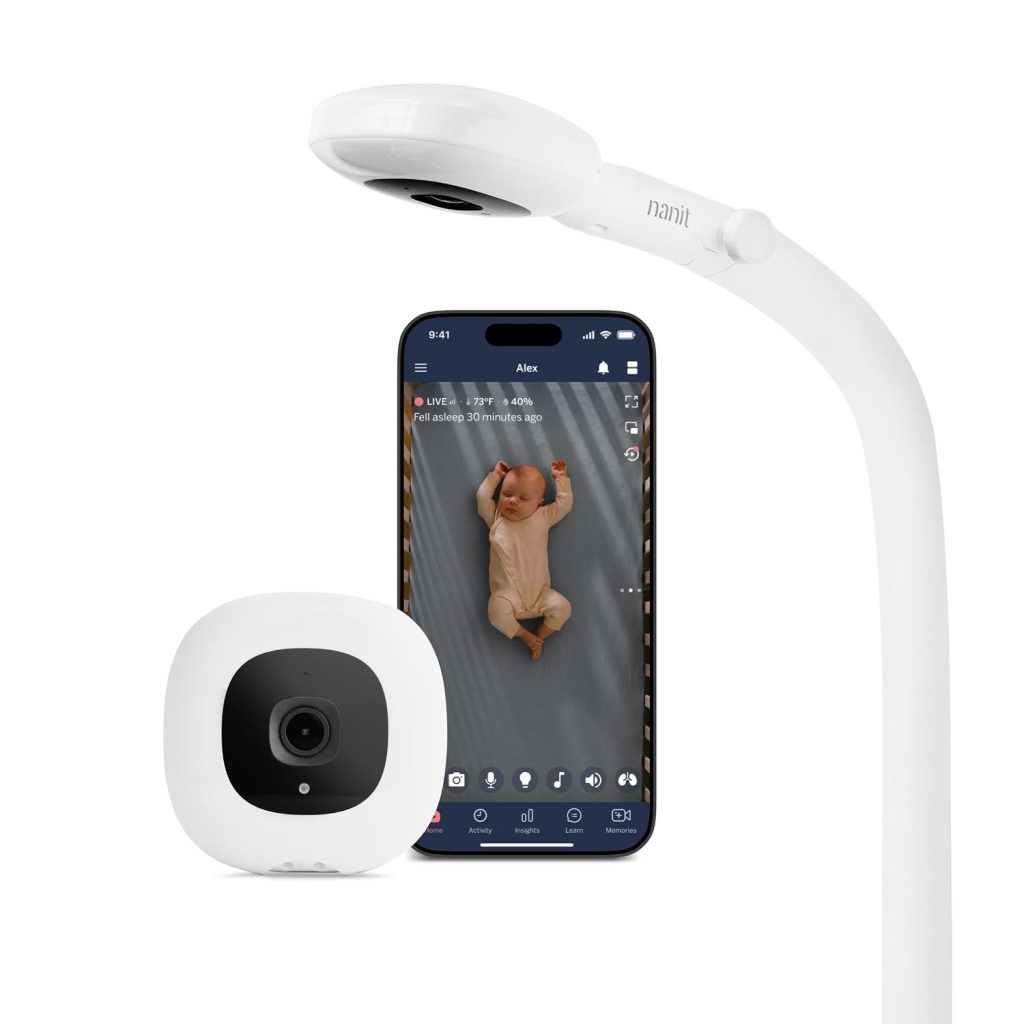
Owlet vs Nanit: Comparison Table
| Owlet Dream Duo (Gen 3) | Nanit Pro | |
|---|---|---|
| Tracking | Pulse rate, oxygen, skin temperature, and sleep from the Dream Sock | Breathing motion through the Breathing Wear pattern; nothing worn |
| Camera | 2K HD camera | 1080p camera, overhead bird’s-eye crib view; floor stand adjusts up to 67 inches |
| Night viewing | Night vision for dark-room viewing | Night vision for dark-room viewing; overhead angle keeps the whole crib in frame |
| Audio | Two-way talk through the app; background audio so you can keep listening while using your phone for other things | Two-way talk through the app; background audio so you can keep listening while using your phone for other things |
| Alerts and insights | Alerts when readings leave preset ranges, delivered through the app and the base station; Predictive Sleep Technology; camera carries the SGS Cybersecurity Mark | Cry detection, sound and motion alerts, breathing-motion alerts, temperature and humidity sensing; sleep reports covering duration, wake-ups, and patterns over time |
| Setup and mounting | Camera sits on a tabletop or mounts on the wall; sock routine becomes part of bedtime; sock and base station travel with you | Overhead mounting via wall mount or floor stand; wall mounting is permanent, the floor stand avoids drilling but takes up room; overhead setup is needed again at each new location |
| Subscription and free tier | Dream App readings included without a subscription; Owlet360 optional paid tier for deeper insights | Live view, alerts, two-way audio, and temperature and humidity readings included without a subscription; Nanit Insights subscription after an included trial for full sleep history and analytics; trial length varies |
| Parent unit | None — app and phone based | None — app and phone based |
| Medical status | Dream Sock is FDA-cleared, stated exactly that way; neither system is a medical device | Neither system is a medical device; no monitor can guarantee safety |
| Image | Product | Features | Price |
|---|---|---|---|
| Check Price | ||
| Check Price |
The One Question That Decides It: What Do You Actually Want Measured?
Before comparing cameras and apps, settle what kind of reassurance you are buying. Nanit answers the question “is my baby still moving while breathing?” It watches the Breathing Wear pattern and reads the visible rise and fall of breathing. Owlet answers a different question: “are my baby’s pulse rate and oxygen in their usual ranges?” It measures those values directly from the sock.
Neither answer is better in the abstract. A parent who lies awake wondering about breathing motion will not be calmed by a pulse reading, and a parent who lies awake wondering about oxygen will not be calmed by a sleep chart. Work out which question keeps you up, and half the decision is made. Note too that the two systems measure different things rather than the same thing twice, so some families use one for video and sleep insight and the other for vitals.
Round 1: Camera Quality and Night Viewing
On stated resolution, Owlet takes it — 2K against 1080p. Nanit fights back with position. Its overhead, bird’s-eye crib view shows the whole sleep space in one frame, which many parents will value more than extra pixels. When a baby shifts to the far corner of the crib, the overhead frame still shows them; a side-angle camera can leave you guessing at depth and position.
Both cameras cover night viewing, so dark-room checks are part of either system rather than a deciding factor. Here again the angle matters more than the spec: Nanit’s overhead position means fewer shadows across the frame during the night.
Round 2: Wearable vs Sensor-Free Tracking, and the Alerts Each One Sends
This is the real fight. Owlet’s sock tracks pulse rate and oxygen directly, data Nanit doesn’t offer, and sends alerts when readings leave preset ranges — through the app and through the base station, so an alert can reach you even when your phone is not in your hand. Nanit’s answer is that nothing touches your baby: breathing motion is read from the Breathing Wear pattern, and alerts cover breathing motion alongside cry, sound, and motion, plus room temperature and humidity for context on a restless night.
If a sock slipping off at 2 a.m. would drive you mad, Nanit feels calmer. If you want vitals, there’s only one choice. And the alert styles differ in kind, not just in number: Owlet alerts you about measured values leaving a range; Nanit alerts you about movement, sound, and the room around the baby.
Round 3: Sleep Insights and Alerts
Owlet offers Predictive Sleep Technology, and it highlights that its camera carries the SGS Cybersecurity Mark. Its sleep picture is built around the sock’s overnight readings and sleep state, with deeper trends and morning reports sitting in the optional Owlet360 tier.
Nanit counters with the fuller sleep diary. Its reports cover how long the baby slept, when they woke, and how patterns change over time, alongside cry detection, sound and motion alerts, and room temperature and humidity — context for a restless night, not just a ping. If your goal is to understand and improve sleep routines, Nanit’s reporting is the deeper tool. If your goal is overnight vitals with sleep as a secondary picture, Owlet’s is the one that matches.
Round 4: Setup, Mounting, and Travel
Nanit’s floor stand adjusts up to 67 inches, helping you get that overhead angle without fixing anything to the wall. The wall mount gives the same overhead view permanently, but it means drilling and a fixed position — worth weighing if you rent, or if the nursery layout may change. The floor stand avoids drilling, at the cost of a larger footprint in the room.
With Owlet, setup includes the sock routine, which becomes part of bedtime: sock on, sensor checked, base station in place. The camera itself is the flexible half of the system, sitting on a tabletop or mounting on the wall. For travel, the sock and base station move easily to a grandparent’s house or a second location, while Nanit’s overhead view has to be set up again wherever you go.
Round 5: The App You Will Live In
Both systems are app-only, and that shapes everyday life more than any single feature. Your phone becomes the monitor, so you need Wi-Fi in the nursery and wherever you are in the house, and you need to be comfortable with the battery and attention cost of keeping the monitor on your phone. Both apps offer two-way talk, so you can soothe from another room without walking in, and both offer background audio, so you can keep listening while using your phone for other things. Both let you share access with a partner, caregiver, or grandparent. The difference is emphasis: Nanit’s app is built around sleep reports and routines, while Owlet’s app is built around live readings and alerts. Pick the home screen you will want to open at 3 a.m.
Round 6: False Alarms and Everyday Frustrations
Every tracking method has a failure mode, and knowing it in advance saves midnight frustration. On Owlet’s side, the sock can slip off or lose contact, especially with active babies, and a loose sock can trigger an alert for what turns out to be a fit problem rather than a readings problem. The sock also needs charging as part of the routine, and babies outgrow sock sizes.
On Nanit’s side, tracking depends on the camera seeing the Breathing Wear pattern. If the baby rolls into a position where the pattern is hidden, or the band or swaddle bunches up, tracking can drop and the system may report that breathing is not detected when the baby has simply shifted. Breathing Wear pieces are likewise outgrown as the baby grows. Neither failure mode means the product is broken; both mean the system asks something of you — a well-fitted sock on one side, a visible pattern on the other.
What Most Reviews Won’t Tell You: The Subscription Truth
Here’s the fine print. Owlet360 is an optional paid tier for deeper insights, including sleep position, historical trends and morning reports — but the Dream App’s readings themselves are included without a subscription. Nanit Insights is also a subscription, after an included trial — and the trial length varies, so don’t trust a roundup that states one fixed number. Nanit’s live view, alerts, two-way audio, and temperature and humidity readings are included without a subscription; the paid tier is what unlocks the full sleep history and analytics.
Decide up front whether the paid tier is worth it for your family, on both sides. The honest way to compare the two systems is free tier against free tier first, and paid tier against paid tier second — not one side’s full package against the other’s basic one.
Safety, FDA Status, and What These Monitors Cannot Do
The Dream Sock is FDA-cleared, stated exactly that way, for the Sock itself. That clearance covers the sock’s pulse-oximetry readings and notifications; it does not make either system a medical device, and it does not mean either monitor diagnoses, treats, or prevents any illness. For context, the original Owlet Smart Sock drew a regulatory warning in 2021 and was withdrawn from sale in the United States; the Dream Sock is the successor that later received clearance. That history is worth knowing, and it is also the reason to keep the wording narrow: cleared sock, not a medical monitoring system.
Neither monitor can prevent sudden infant death, and no monitor replaces safe-sleep practice: baby on their back, on a firm, flat surface, every time. Register both products so safety notices reach you, and check any secondhand unit against the recall database before buying.
Pros and Cons
Seven rounds in, the pattern from our comparison holds: Owlet gives you more data, Nanit asks less of your baby. Here is each side in short form, drawn only from what the makers state above.
Owlet Dream Duo (Gen 3)
Pros
- Tracks pulse rate, oxygen, skin temperature, and sleep from the Dream Sock — vitals data Nanit does not offer
- 2K HD camera, the higher stated resolution of the two
- The Dream Sock is FDA-cleared, stated exactly that way
- Predictive Sleep Technology, and the camera carries the SGS Cybersecurity Mark
- Alerts through the app and the base station; readings included without a subscription
- Flexible camera placement, and the sock and base station travel easily
Cons
- It is a wearable: the sock can slip off, needs charging, and putting it on becomes part of the bedtime routine
- Babies outgrow sock sizes as they grow
- Deeper insights — sleep position, historical trends, morning reports — sit in the optional paid Owlet360 tier
- No dedicated parent unit; the system lives on your phone and needs Wi-Fi
Nanit Pro
Pros
- Nothing worn: breathing motion is tracked through the Breathing Wear pattern, and a Breathing Wear Band is included with camera bundles
- Overhead bird’s-eye view shows the whole crib in one frame; the floor stand adjusts up to 67 inches, and a wall mount option exists
- Cry detection alongside sound and motion alerts
- Temperature and humidity sensing for room context
- Fuller sleep reports: duration, wake-ups, and patterns over time
- Live view, alerts, two-way audio, and room readings included without a subscription
Cons
- 1080p camera — a lower stated resolution than Owlet’s 2K
- No pulse rate or oxygen data; tracking is breathing motion only
- Tracking can drop if the baby rolls so the Breathing Wear pattern is hidden, or if the band or swaddle bunches
- Breathing Wear pieces are outgrown as the baby grows
- Nanit Insights is a subscription after the included trial, and the trial length varies
- No dedicated parent unit; app and phone based, and dependent on Wi-Fi
Buying Guide: Which Should You Choose, and for Whom?
Choose Owlet if pulse rate and oxygen tracking will genuinely help you relax, if the question keeping you up is about vitals rather than routines, or if you want a system whose readings travel easily to a grandparent’s house or a second location. Accept the sock routine at bedtime, the charging, and the optional Owlet360 tier for deeper insights.
Choose Nanit if you want breathing motion tracking and a clear overhead view with nothing on your baby, if your goal is understanding and improving sleep routines over time, or if the idea of a nightly wearable would bother you more than it reassures you. Accept a lower stated camera resolution and the Nanit Insights subscription after its trial.
Consider both if your household wants video and sleep insight and vitals — for example, a nursery where one adult watches the crib and another watches the numbers, or a home where the camera stays put and the sock travels. They measure different things, so pairing them is not duplication.
Three questions to settle it: First, does your anxiety come from vitals or from sleep routines? Second, will your baby tolerate a sock every night, or do you want nothing worn? Third, does your home suit a permanent overhead mount, or do you need a setup that moves? Vitals plus sock tolerance points to Owlet; routines plus nothing worn points to Nanit; a travelling or second-location setup favours the sock, while a fixed nursery favours the overhead camera.
Verdict
Our pick splits by household. Choose Owlet if pulse rate and oxygen tracking will genuinely help you relax. Choose Nanit for breathing motion tracking and a clear overhead view with nothing on your baby. Pick the philosophy you’ll still like in month six.
Conclusion
Our pick splits by household. Choose Owlet if pulse rate and oxygen tracking will genuinely help you relax, accepting the sock routine at bedtime and the optional Owlet360 tier for deeper insights. Choose Nanit for breathing motion tracking and a clear overhead view with nothing on your baby, accepting a lower stated camera resolution and the Nanit Insights subscription after its trial. Pick the philosophy you will still like in month six, knowing neither system is a medical device and neither can guarantee safety.
FAQ
Is either monitor a medical device?
No. The Dream Sock is FDA-cleared, as Owlet words it, but neither system is a medical device and no monitor can guarantee safety.
Can either monitor prevent sudden infant death?
No. Neither monitor diagnoses, treats, or prevents any illness. Follow safe-sleep practice regardless of which monitor you use: baby on their back, on a firm, flat surface, every time.
Do both need a subscription?
No. The paid tiers are optional — Owlet360, and Nanit Insights after its included trial. Core monitoring works without them on both sides; the paid tiers unlock deeper insights and full history.
Does either come with a parent unit?
No. Both are app and phone based, and both need Wi-Fi in the nursery and wherever you are.
Do I need Wi-Fi for either monitor?
Yes, in practical terms. Both stream to a phone app over Wi-Fi, so a reliable connection in the nursery and where you will be checking from is part of owning either system.
Can a partner, caregiver, or grandparent check in too?
Yes. Both apps let you share access with other adults, so more than one person can view the camera or the readings.
What happens if the sock slips off, or the baby rolls over?
A slipped sock can trigger an Owlet alert for a fit problem rather than a readings problem, so check the fit first. On Nanit’s side, if the baby rolls so the Breathing Wear pattern is hidden, or the band bunches up, breathing-motion tracking can drop until the pattern is visible again.
Which is better for travel?
Owlet’s sock and base station move most easily, since the wearable travels with the baby. Nanit’s overhead view can move too, but the stand or mount setup has to be arranged again at each new location.
Does Nanit track breathing without the Breathing Wear?
No. Breathing-motion tracking reads the Breathing Wear pattern, so the band or swaddle needs to be in view of the camera for that feature to work.
Which is better for sleep training?
Nanit, in our comparison: its reports on duration, wake-ups, and patterns over time are built for understanding and improving routines. Owlet’s strength is overnight vitals, with sleep as the secondary picture.


