
PetSnowy SNOW+ Review: Auto-Packing, Low-Odor Design
This petsnowy snow plus review covers the litter box for owners who care most about odor and waste handling: an auto-packing system that seals waste into a 10L pull-out drawer, roughly 83L of interior, and a TiO2 layer that helps reduce odor. It suits cats from 3.3 to 20 lb, and packing refills are a running cost. That running-cost reality is the honest starting point for any petsnowy litter box search — the packing system is the feature, and its refills are part of the deal.
Most self-cleaning litter boxes solve half the problem: they rake or rotate the waste away, but you still end up handling an open bin of it days later. The PetSnowy SNOW+ is designed around the other half — it auto-packs the waste, sealing it away as part of its low-odor design, so the part of litter duty everyone hates most is the part it automates. That half-problem framing is where a best automatic litter box search should start — not with the cleaning cycle alone, but with what happens to the waste after it.
Key Takeaways
- Headline feature: auto-packing — waste is packed and sealed away automatically, instead of sitting in an open bin you empty by hand.
- Waste drawer: a 10L pull-out drawer, with roughly 83L of interior space.
- Odor control: a TiO2 layer that helps reduce odor — it helps, it is not odor-free.
- Cat weight range: 3.3 to 20 lb — skip it if your cat is over the weight limit.
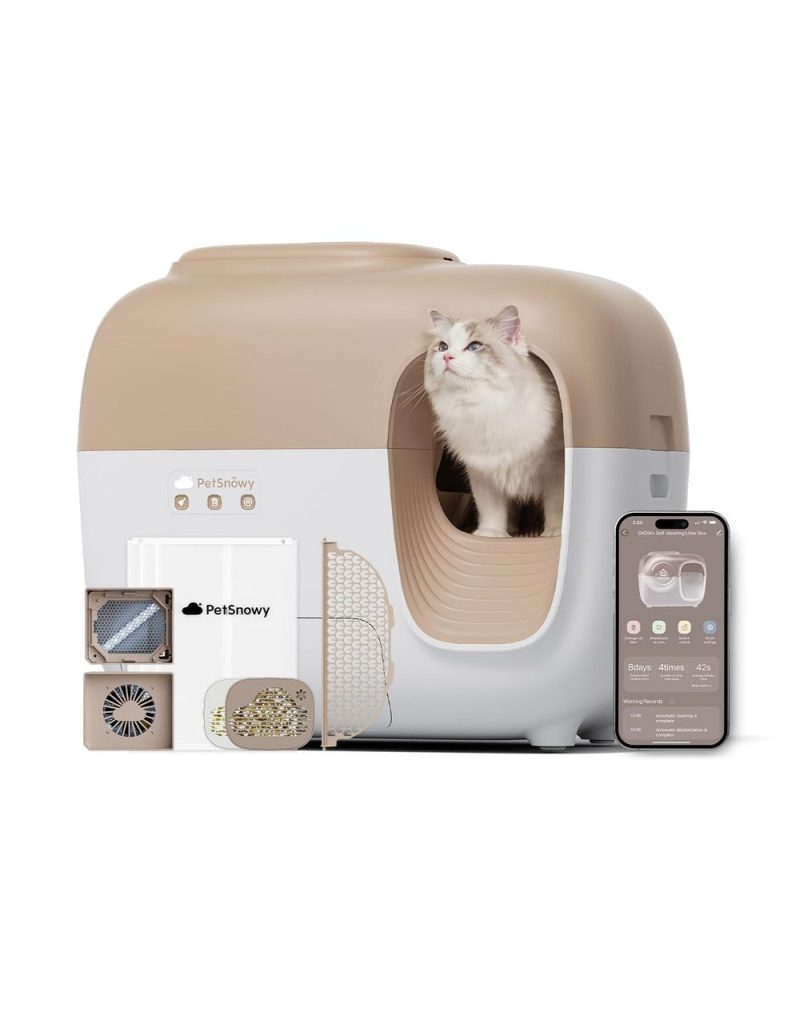
- Design and running cost: a two-tone design (taupe-brown upper shell over a cream-white lower housing) with a recessed arched entrance and top handle, that looks more like furniture than pet equipment; budget for packing refills either way.
Key Specs at a Glance
| Spec | PetSnowy SNOW+ |
|---|---|
| Waste handling | Auto-packing — waste is packed and sealed away automatically |
| Waste drawer | 10L pull-out drawer |
| Interior space | Around 83L |
| Cat weight range | 3.3 to 20 lb |
| Odor control | TiO2 layer that helps reduce odor (not odor-free) |
| Design | Taupe-brown upper shell over a cream-white lower housing; recessed arched entrance; top handle |
| Shop | View on Amazon |
In our litter box comparison on Smart Tech & Gadget Finds, the SNOW+ was the one built around waste handling first. Most boxes move waste out of sight and stop there; this one packs and seals it, and that difference is the whole pitch.
Key Features
- Auto-packing waste: Instead of leaving waste sitting in an open collection bin, the SNOW+ packs it away automatically — the core of its low-odor approach.
- TiO2 odor-reduction layer: The design includes a TiO2 layer intended to help reduce odor. Note the honest wording: it helps reduce odor — no litter box is completely odor-free, and this one does not claim to be.
- Pull-out waste drawer: A 10L drawer handles the packed waste, so emptying is a drawer pull rather than a bin dig.
- Generous interior: Around 83L of interior space, with a recessed arched entrance that gives the unit a clean, furniture-like face.
- Two-tone design: Taupe-brown upper shell over a cream-white lower housing, with a top handle for moving the unit.
Pros and Cons
Pros
- Auto-packing seals waste away instead of leaving it sitting in an open bin — the core of its low-odor approach.
- The 10L pull-out drawer makes emptying a drawer pull rather than a bin dig.
- Around 83L of interior space gives cats in the rated range room to use it comfortably.
- The two-tone design looks more like furniture than pet equipment, which matters when the box lives near living space.
Cons
- The weight range is a hard limit: cats over 20 lb need a larger box, and kittens under 3.3 lb should only use it in supervised or manual mode.
- Auto-packing uses consumables, so refills are an ongoing cost on top of the purchase.
- The TiO2 layer helps reduce odor — no litter box is completely odor-free, and this one does not claim to be.
When we lined the SNOW+ up against the other boxes in our comparison, the waste drawer was what stood out. Sealed, packed waste in a pull-out drawer is simply a cleaner handoff than an open collection bin. That drawer-first difference is why a best self cleaning litter box search should weigh the waste handoff, not just the cleaning cycle.
What to Know Before You Buy
Weight limits matter with this box. It is made for cats between 3.3 and 20 lb. Cats above that range need a larger box, and kittens under 3.3 lb should only use it in supervised or manual mode, because automatic cycles on any self-cleaning box rely on the cat being heavy enough to register properly. If you have a tiny kitten, plan to run it manually until the kitten grows into the rated range. That weight-limit check is the practical test behind any petsnowy automatic litter box search — whether your own cat fits the box, not just whether the box cleans itself.
Also consider what “auto-packing” means for running costs: packing systems use consumables, so check the current listing for what the SNOW+ uses and what refills cost. That ongoing cost is the trade-off for never handling loose waste — for many owners it is worth it, but it should be a conscious decision, not a surprise.
Footprint: Measure First
Competitor reviews raise footprint as its own topic for auto-packing boxes, and the generic rule is simple: measure the cat first, then the room, then the access. An auto-packing box is a piece of furniture, not a tray, so the space it needs includes the room to open it, empty the drawer, and clean around it. No dimension figure is stated here, and no footprint claim is made here for this box. Measure the floor space, the drawer pull, and the access clearance before you order, and leave room to reach the waste area without moving the box every time. Check the listing for your exact model for its footprint before you buy.
Noise as a Buying Factor
Competitor reviews raise noise as a buying factor for automatic boxes, and the honest check is comparative, not numerical — run the first cycles while you are home and judge the sound yourself during the return window. Noise matters twice in a pet home: it startles the cat, and it disturbs the household if the box sits near a bedroom. A box that cleans on a schedule at night will be heard, so placement near sleeping areas deserves the same thought as placement near the cat’s usual spot. No noise figure and no quietness claim are made here for this box, because this review makes no noise claim at all — judge the sound yourself, in your own home, during the return window.
Brand Background and Seller Check
Competitor guides list brand background as a buying topic, and the generic version is about support, not history. A brand with an established support channel is easier to reach when a machine the cat depends on stops cycling, and a seller check matters just as much: confirm the seller is authorized for your region before you pay, so warranty and returns run through a channel that will answer. Shipping is part of the same check — confirm delivery terms and return shipping terms on the listing before you order, rather than assuming them. No brand history claim is made here, no founding date is stated here, and no seller is named here. Check the listing for your exact model and seller before you buy.
Warranty and Returns as Buying Criteria
Competitor guides list warranty, returns, and service as buying criteria, and for a product the cat may refuse, they matter more than usual. A return window is the period in which you learn whether your cat accepts the box at all. A return policy is what stands behind that window if the cat does not. A warranty covers the machine itself over a longer horizon, and responsive service matters when a machine the cat depends on stops cycling. Those are criteria to compare across listings, not claims — this review states no warranty, return, or service terms for this box, and none is stated here. Check the listing for your exact model for its terms before you buy, and confirm the return window covers the transition period your cat needs.
Litter-Type Compatibility: Check the Listing First
Competitor reviews list litter-type compatibility as a check before you buy an automatic box, and the reason is mechanical: the wrong litter can jam a cycle or leave clumps the packing part cannot handle. Those reports are not verified by this review, and no litter compatibility is claimed here for this box. The only safe rule is the listing and manual for your exact model — check which litter types it accepts before you buy, and do not assume the litter you already use will work. No litter compatibility is claimed here for this box.
Power and Power-Outage Questions
Competitor reviews raise power as a topic for automatic boxes, and the generic version is a set of listing questions, not claims: what power does the box need, where does the cord run, and what happens to a scheduled cycle if the power drops. Those are questions to ask on the listing and manual for your exact model before you buy. No power figure is stated here, and no outage-behavior claim is made here for this box, because this review establishes none of those. Do not assume a cycle resumes on its own after an outage — check the manual.
Cost of Ownership: The Whole Picture
This review already names the running-cost point — packing systems use consumables, and the listing is where to check what the box uses and what refills cost — and the generic extension is simple: judge the box by its whole cost over time, not by the box alone. Refills are the recurring part, and any replacement parts add their own rhythm on top. No price, refill cost, or total figure is stated here, because prices shift and vary by retailer. The honest comparison is total cost over time against the daily chore the box removes — and that comparison only favors the box if the cat actually uses it. Check the listing for your exact model for its consumable list before you pay. No cost claim is made here for this box beyond the running-cost point this review already names.
Setup and First Days: Generic Guidance
Competitor reviews raise setup as a topic, and the generic guidance fits this review well. Place the box where the cat already goes, let the cat investigate it unpowered first, and run the first cycles supervised so you see the behavior yourself. Keep a familiar backup box available during the transition, so the cat never has to choose between the new box and no box at all. No setup claim is made here for this box beyond that generic guidance, because this review states nothing about setup — check the manual for your exact model for its setup guidance before you buy.
Odor Mechanism: What to Ask About
Competitor reviews raise odor mechanism as a topic, and the generic version is a set of questions, not claims: how does the box seal waste, what deodorizing element does it use, and what happens to odor when the drawer fills. Those are listing questions, not claims — this review’s own odor stance stands as written (a layer that helps reduce odor, plus sealed packing, and explicitly not odor-free), and no further odor claim is made here. The honest check is practical, not numerical: waste changed on time and a ventilated spot do more for odor than any single option name. Check the listing for your exact model for how it handles waste and odor before you buy. No odor result or odor-system claim is made here for this box.
Scatter Control: Generic Tips
Litter outside the box is the everyday complaint competitor reviews raise for large boxes, and the generic tips are practical rather than product claims. A mat under and around the entrance catches scatter before it spreads. Placement away from high-traffic paths keeps kicked litter in one area. A regular sweep of the entrance area matters more than any single mat or tray, because tracking is a daily habit problem, not a one-time fix. No scatter result is claimed here for this box, and no tip here is presented as a feature of this box. Check the listing for your exact model for its entrance layout before you buy, and judge scatter with your own cat during the first weeks.
Owner Feedback: Read Recent Reviews, Not Launch-Day Ones
Competitor reviews synthesize owner feedback as part of their method, and the generic lesson for buyers is about timing: launch-day impressions tell you about setup, while recent owner feedback tells you about months of use. Read recent feedback before you buy, run the first cycles supervised so you see the behavior yourself, and judge the box during the return window rather than on launch-week impressions alone. No owner quote is reproduced here, no review theme is stated as a fact about this box, and no reliability claim is made here for this box.
Acclimation: The Fallback
This review already covers supervised and manual use for kittens below the rated range, and the fallback below extends that guidance rather than replacing it. If the cat still avoids the box after a gradual introduction, step back a stage instead of forcing it: return to the box powered off beside the old box, let the cat set the pace again, and keep the old box available so the cat never has to choose between the new box and no box at all. If avoidance continues, ask your vet whether stress, pain, or a medical issue is behind it, and accept that a standard box the cat uses beats an automatic box it will not enter. No timeline is promised here, because cats vary; the stages above are the method, not a schedule. No acceptance outcome is claimed here for this box.
Deep-Cleaning Reality: What Still Needs You
Self-cleaning does not mean never cleaning, and competitor reviews are clear about what still needs manual work. The waste area needs emptying on its own schedule. The chamber and entrance areas need wiping to stop buildup and odor. Litter dust collects in corners and tracks the cycle never reaches. Deep-cleaning means taking the washable parts apart on the manual’s schedule and cleaning them by hand — the cycle handles daily scooping, not maintenance. Check the manual for your exact model for its cleaning schedule and which parts are washable. No cleaning interval is stated here as a fact for this box.
Minimum Cat Age: A Listing Check Only
Competitor reviews raise minimum cat age as a topic, and the generic version is a listing check, not a claim. This review gives a weight threshold, not an age, and the two are not interchangeable: a small kitten can be old enough in weeks yet still below the sensing range, and a young cat can be heavy enough yet still need supervised first cycles. No age figure is stated here, and no age claim is made here for this box. Check the listing and manual for your exact model for its age guidance before you buy, and if you are unsure, ask your vet whether an automatic box fits your kitten’s situation.
XL-Breed Fit: An Extension of the Article’s Own Guidance
This review already directs giant breeds over the weight limit to the extra-large options in the roundup, and the generic extension is simple: a large cat needs interior room to turn and use the box comfortably, and a box shaped for average cats can feel cramped for a big breed even when the weight guidance looks close. No size or weight figure is stated here, and no fit claim is made here for this box. Measure your cat’s needs against the listing for your exact model, and watch how your own cat enters and uses the box during the first supervised cycles. No fit claim is made here for this box.
App Questions: Listing Checks Only
Competitor reviews raise app-connected features as a topic, and the generic version for this box is a set of listing questions only, because this review establishes no app features at all. The questions to ask on the listing are generic: does the box offer app control, what does the app track if it does, and does core cleaning still work if the connection drops. Those are questions, not claims — no app feature is claimed here for this box, and none is added here. Do not assume a feature listed on a product page works without a connection, and do not assume this box offers any particular app feature. Check the listing for your exact model before you buy.
Who It’s For
The SNOW+ is for apartment owners and anyone whose litter box lives near living space, where odor control is not a luxury. It suits cats in the 3.3–20 lb range whose owners want the most hands-off waste experience available in this category. If your cat is a giant breed over the weight limit, look at the extra-large options in our roundup instead. That near-living-space case is where a petsnowy self cleaning litter box search should start — odor control where you actually live, not in a spare room.
FAQ
What does auto-packing actually do?
Instead of leaving waste sitting in an open collection bin, the SNOW+ packs it away automatically and seals it. That sealed handoff is the core of its low-odor design, and the packed waste sits in a 10L pull-out drawer.
Which cats can use the SNOW+?
Cats between 3.3 and 20 lb. Cats above that range need a larger box. Kittens under 3.3 lb should only use it in supervised or manual mode, because automatic cycles rely on the cat being heavy enough to register properly.
Is the SNOW+ odor-free?
No, and it does not claim to be. The TiO2 layer helps reduce odor, and the auto-packing keeps waste sealed. That is a real step up from an open bin, but no litter box is completely odor-free.
Are there running costs?
Yes. Packing systems use consumables, so check the current listing for what the SNOW+ uses and what refills cost. That ongoing cost is the trade-off for never handling loose waste.
Who should skip the SNOW+?
Owners of giant breeds over the 20 lb limit — look at the extra-large options in our roundup instead. Owners with a kitten under 3.3 lb can still use it, but should plan on manual mode until the kitten grows into the rated range.
How do I check footprint before buying?
Measure the cat first, then the room, then the access. An auto-packing box is a piece of furniture, not a tray, so the space it needs includes the room to open it, empty the drawer, and clean around it. No dimension figure is stated here, and no footprint claim is made here for this box. Check the listing for your exact model for its footprint before you order, and leave room to reach the waste area without moving the box every time.
Is an auto-packing box noisy?
It depends on the model and on placement. A box that cleans on a schedule at night will be heard, and a nervous cat may startle at a new sound regardless of volume. The honest check is comparative, not numerical: run the first cycles while you are home and judge the sound yourself during the return window. No noise figure and no quietness claim are made here for this box, because this review makes no noise claim at all.
What litter works in an auto-packing box?
There is no single answer, because it depends on the mechanism. Some designs suit sifting litter well, while other litter types suit other designs, and the wrong litter can jam a mechanism or leave clumps the packing part cannot handle. Those reports are not verified by this review, and no litter compatibility is claimed here for this box. The only safe rule is the listing and manual for your exact model — check which litter types it accepts before you buy, and do not assume the litter you already use will work.
What happens if the power goes out?
That depends on the model, so check the listing and manual before you buy. The generic questions are: does a scheduled cycle resume on its own, do manual controls still work, and does anything you set stay set when the power returns. Those are listing checks, not claims — this review makes no outage-behavior claim about this box, and none is made here. Do not assume a cycle resumes on its own after an outage.
What should I check about warranty and returns before buying?
Three things: the return window, what the return policy covers if your cat refuses the box, and the warranty on the machine itself. Those are criteria to compare across listings, not claims — this review states no warranty, return, or service terms for this box, and none is stated here. Confirm the return window covers the transition period your cat needs before you order.
How hard is deep-cleaning an auto-packing box?
Harder than daily scooping, and that is the point buyers miss. The cycle handles daily waste, but the chamber, entrance, and waste areas still need wiping, and the washable parts still need taking apart on the manual’s schedule and cleaning by hand. No cleaning interval is stated here as a fact for this box. Check the manual for your exact model for its cleaning schedule and which parts are washable before you buy.
How do I keep litter from spreading?
A mat under and around the entrance catches scatter before it spreads, placement away from high-traffic paths keeps kicked litter in one area, and a regular sweep of the entrance area matters more than any single mat or tray. No scatter result is claimed here for this box, and no tip here is presented as a feature of this box. Check the listing for your exact model for its entrance layout before you buy, and judge scatter with your own cat during the first weeks.
What should I check about app features before buying?
That depends on the model, so check the listing before you buy. The generic questions are: does the box offer app control, what does the app track if it does, and does core cleaning still work if the connection drops. Those are listing checks, not claims — this review establishes no app features for this box, and none is claimed here. Do not assume this box offers any particular app feature.
How These Picks Were Chosen
These picks come from our own Smart Tech & Gadget Finds video comparison of the models in this series, weighed against published manufacturer specifications. No lab test scores, test hours, or units-tested figures are claimed here, because none were run for this review. Design claims quoted in the review are manufacturer-advertised descriptions, and the review says so wherever they appear, so check the current listing for the model you want.
Final Verdict
The PetSnowy SNOW+ is the pick for owners who care most about odor and waste handling. Auto-packing, a sealed 10L drawer, and a TiO2 layer that helps reduce odor add up to the most hands-off waste experience in this category, in a box that looks like furniture. Buy it if your cat sits in the 3.3 to 20 lb range and the litter box lives near your living space. Skip it if your cat is over the weight limit, and budget for packing refills either way — that cost is part of the deal, not a surprise to find later.
Affiliate Disclosure: This article contains Amazon affiliate links. As an Amazon Associate, Smart Tech & Gadget Finds earns from qualifying purchases at no extra cost to you. #ad


